
iLL.GATES - Founder, Producer Dojo.

Friday, October 09, 2026
Why is it so easy to remix somebody else’s song and so hard to finish your own? The answer is a step in the workflow that’s easy to skip without ever noticing it’s missing.
I call it phase three. You bounce your track out to stems (every sound or group of sounds rendered as its own audio file), and then you remix those stems to finish the song. Your project stops being a pile of plugins and instruments and turns into audio you can chop, flip and rearrange, which is a much easier thing to finish. If you’re stuck on a track right now, I’d bet it’s the step you skipped.
Fractalize the face
Right, so: UHNK showed up at my house with a Riff Raff sample (the one where he raps “in elementary, my favorite shape was a trapezoid,” which is a sentence that has no business being that funny) and I said “that is a very funny sample, let’s go.”
The tune we made is called “Trapezoid”, and every section of it is those same few words edited a different way. One part time stretches the line into a riser. Another goes “trap, trap, trap, trap, trapezoid, trapezoid.” Another yanks the sample out for a few bars (no sample, no sample, no sample) and then the phrase starts up again. I could hear how every one of those edits was going to work before I made it, so writing the thing was a piece of cake, and it wrote itself in about four hours.
So why was that one so easy? It had a face. The face is the main character of a song, the thing a fan would describe if they were trying to tell a friend about your track (“it’s the one where the guy raps about a trapezoid”), and I put about 80% of my effort into it whenever I compose. Everything else in the song is the band, and a good band doesn’t solo over the singer. Trapezoid’s face was the sample. You aren’t done with the first phase of a track until you’ve got one.
Then I fractalized it. Fractalizing means taking one idea and turning it into a whole song’s worth of ideas by editing it, manipulating it and resampling it, so every section is another version of the same seed. Since it all comes from that one seed, it all fits together, even when the changes are pretty drastic. If I could teach you one thing about composing music, it’s this. When you find an idea you like enough to make a song, go deeper into it rather than going back into the bag for more sounds to go with it. Your songs come out cohesive, uncluttered and easy.
A remix starts at phase three
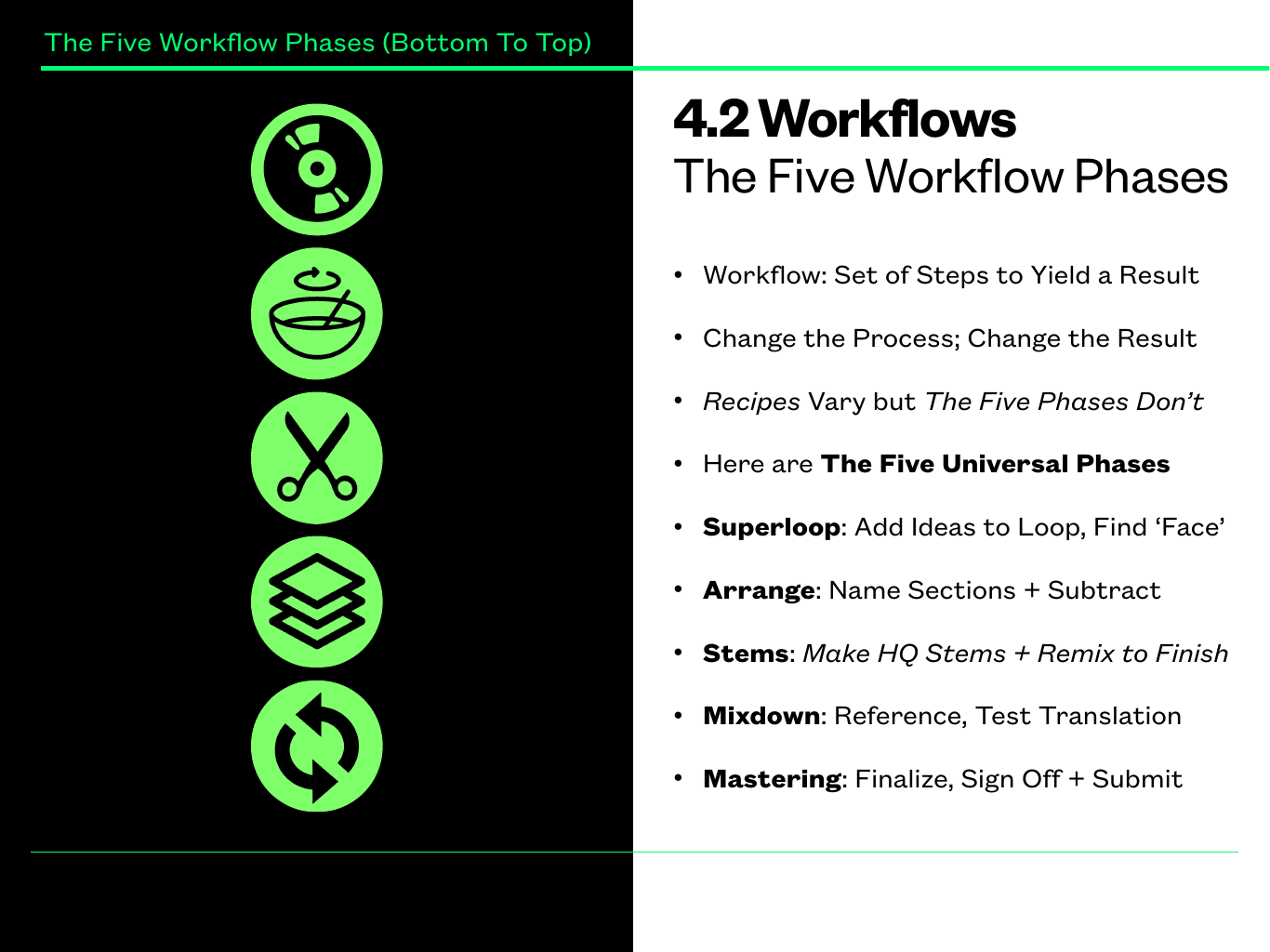
Making a finished piece of music takes five phases. The recipes inside each phase change from track to track, and the five phases stay put:
- Superloop. Loop four to sixteen bars, throw ideas at it, mute and unmute stuff, and keep jamming until you find the face.
- Arrangement. Copy the loop across the timeline until you’ve got five minutes or so, then delete whatever each section doesn’t need. That deleting is called subtractive sequencing.
- Stems. Render the arrangement as high-quality audio, then remix those stems to finish composing.
- Mixdown. Check the mix on different systems, write a list of fixes, go back to the studio, repeat.
- Mastering. One last round of checks before you sign off and make the final render.
A remix starts with stems, so the first thing you do is chop and rearrange audio, and that’s phase three. Your own track starts as a loop and keeps going as a live session right through the arrangement. The path that skips phase three goes straight from arrangement to mixdown, and it ends with an overloaded processor, way too much going on and a project so unwieldy it’s demoralizing. Do phase three and your own song gets the same starting line a remix gets.
What phase three looks like
I start with a save point. Rendering to audio gets called destructive editing, which sounds terrifying, but a save point defuses it, the same way you’d save before a boss fight in a video game. Hit Save As and add notes to the file name, something like “last before stems.” Whatever you do next, your full session is still sitting there.
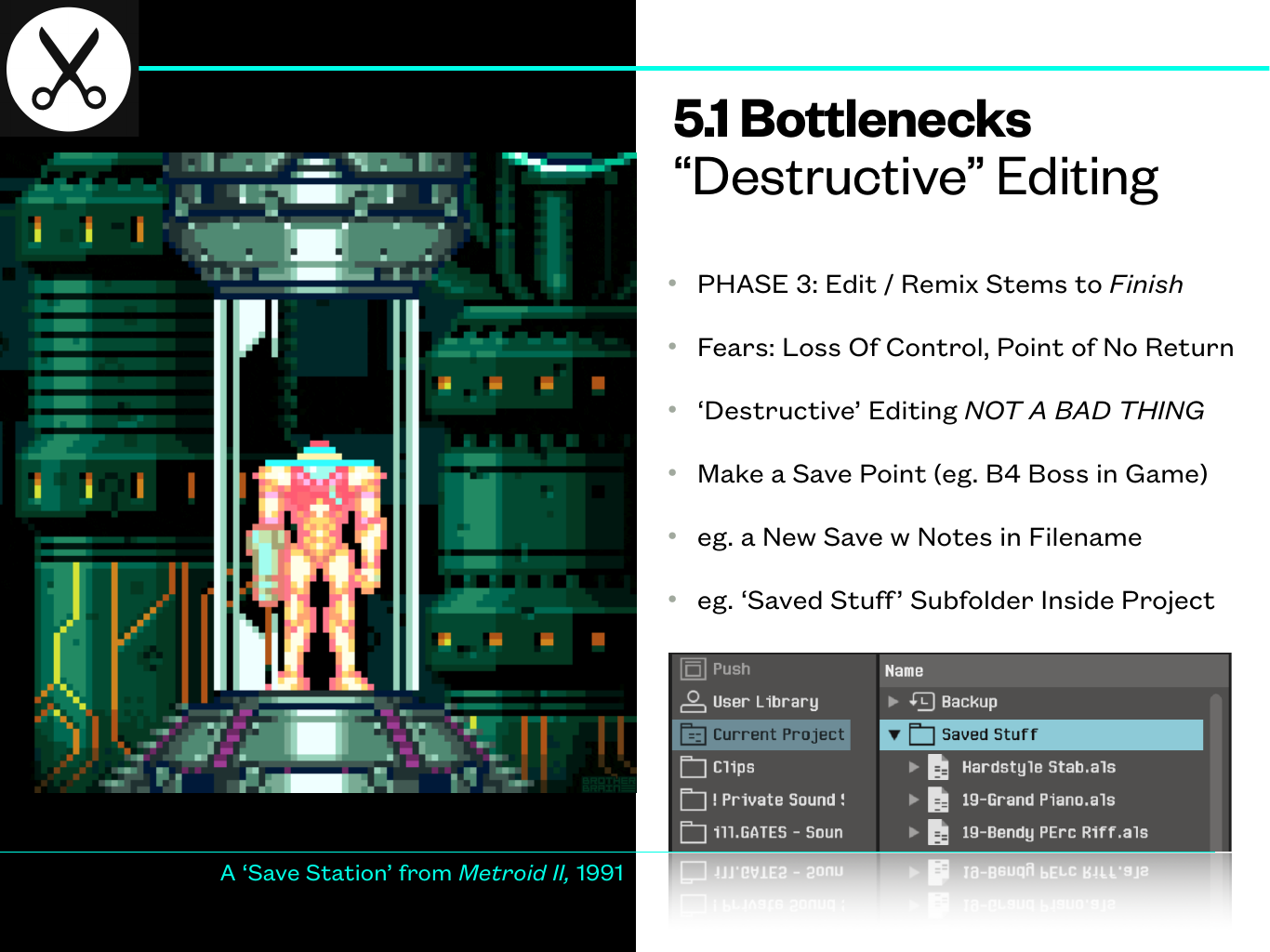
Next I render the stems. Each track or group gets bounced to its own audio file at high quality, with no sounds overlapping, so every piece can be moved later. I use 32-bit floating point at 88.2 kHz, which is double the 44.1 music usually gets released at, and pitched-down samples keep extra highs that way. 44.1 is fine too. Mr. Bill works at 44.1 and all of his stuff sounds pretty good.
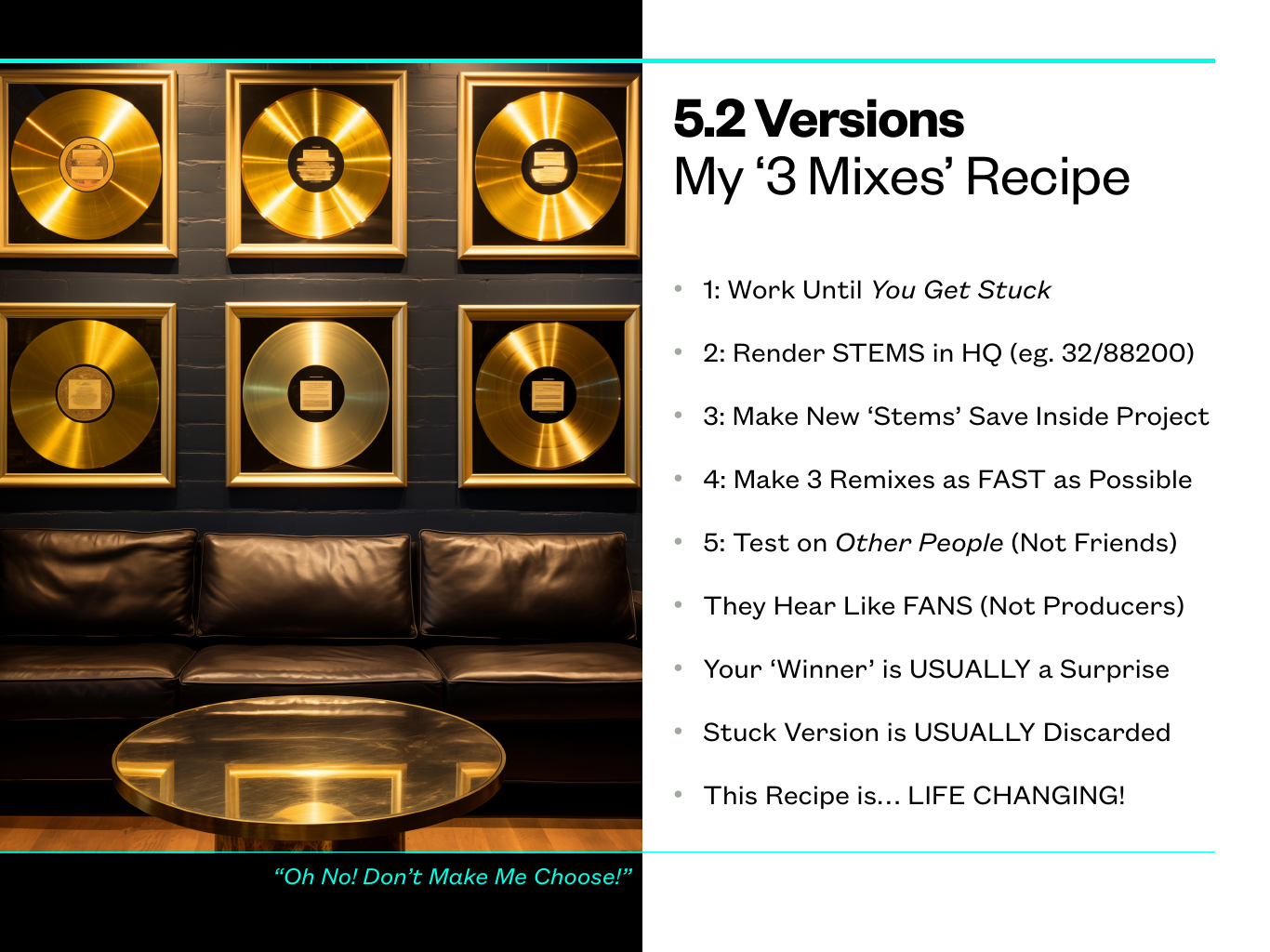
Then I Save As again with “stems” at the end of the name, import the stems into that new save, and make three remixes of them as fast as I possibly can. Each one should be as different from the other two as you can make it. Cut things, rearrange things, drop channels, fix the transitions between sections, and put your new edits on new tracks (I call those remix tracks: the same sound, with new edits on a new channel). The version you were stuck on usually gets dropped, and the three that replace it tend to sound looser and a lot more fun, since the sound design and the riffs are already done and all you’re doing is sequencing. You stop clinging to the channel you spent so long on, since if you miss it, it can go in the other version.
That’s my three versions recipe. I use it on every track now, and it’s a great way to do collabs.
Make a folder inside your project called _saved_stuff as you go, and drag in anything you might want later: presets, samples, whole channels, groups, frozen tracks before you flatten them. Missing Lynx, a Dojo member, turned me on to that one and I wish I’d started doing it ages ago. I’m in Ableton, but a folder works in any DAW.
Joseph Dicasio posted after the 2024 Bootcamp that phase three “gave some unfinished tracks of mine a repurpose,” and that exporting and messing with the stems was “just what I didn’t know I needed.”
Play your versions for strangers
Once you’ve got your three versions, play them for people who are NOT your friends. Friends are there to encourage you, which is a great thing for a friend to do and makes them useless for this. Find another musician, or a fan who’s deep into music, and give them a harshness level out of ten so they know it’s safe to be real with you, since people almost never give you the real answer to your face otherwise. A dance floor full of strangers is ideal. A stranger on the street with your headphones works too, if you compliment their style first and tell them you bet they have great taste in music.
I’m a terrible judge of my own music, and I can prove it. Some time back I put out a track I was sure was one of the best things I’d ever written.
At some point I was teaching somebody that all a good tune needs is a riff, a turnaround and a fat drop, so I banged one out to show them, in about thirty minutes, kinda by accident. No mastering. The song was called Bad Bitches, I thought it was stupid, and I wasn’t going to release it.
Then I needed a track in a particular key to get through a transition in a DJ set, and Bad Bitches was in the right key. I played it and the room lost its goddamn mind. Okay, I figured, one room. I tried it in another set and got the same reaction, and after that people started coming up to tell me it was their favourite song I’d ever made and that it made them want to throw ass. Fine. FINE. I put it out, didn’t take the promo seriously, and used pictures of stupid dogs for the cover. It became my track of the year, which means a thirty-minute joke killed the one I’d been calling my masterpiece.
Keep a render of every save
I version my saves constantly, [track_name]-3, [track_name]-4 and so on, and I keep a render of every one. I used to delete the WAV files to save hard drive space, which I now think was dumb. Ear fatigue is real, and more mixing often makes a track worse. Plenty of times the quick demo from that first hour of arranging beats the same track after twenty more sessions of mixing, and the only way to find that out is to have kept the renders, so you can go back to the early version, press play, and hear for yourself what all that polishing cost you.
You’re going to wreck some sounds along the way, and that’s normal. If you aren’t wrecking a few, you’re probably playing it pretty safe. When a part is cooked, remake it, since you know exactly what you’re aiming at now and it goes way faster the second time. You can’t polish a turd.
The week, day by day
Every class ends with a challenge, and every challenge has an easy version plus harder ones if you want to push.
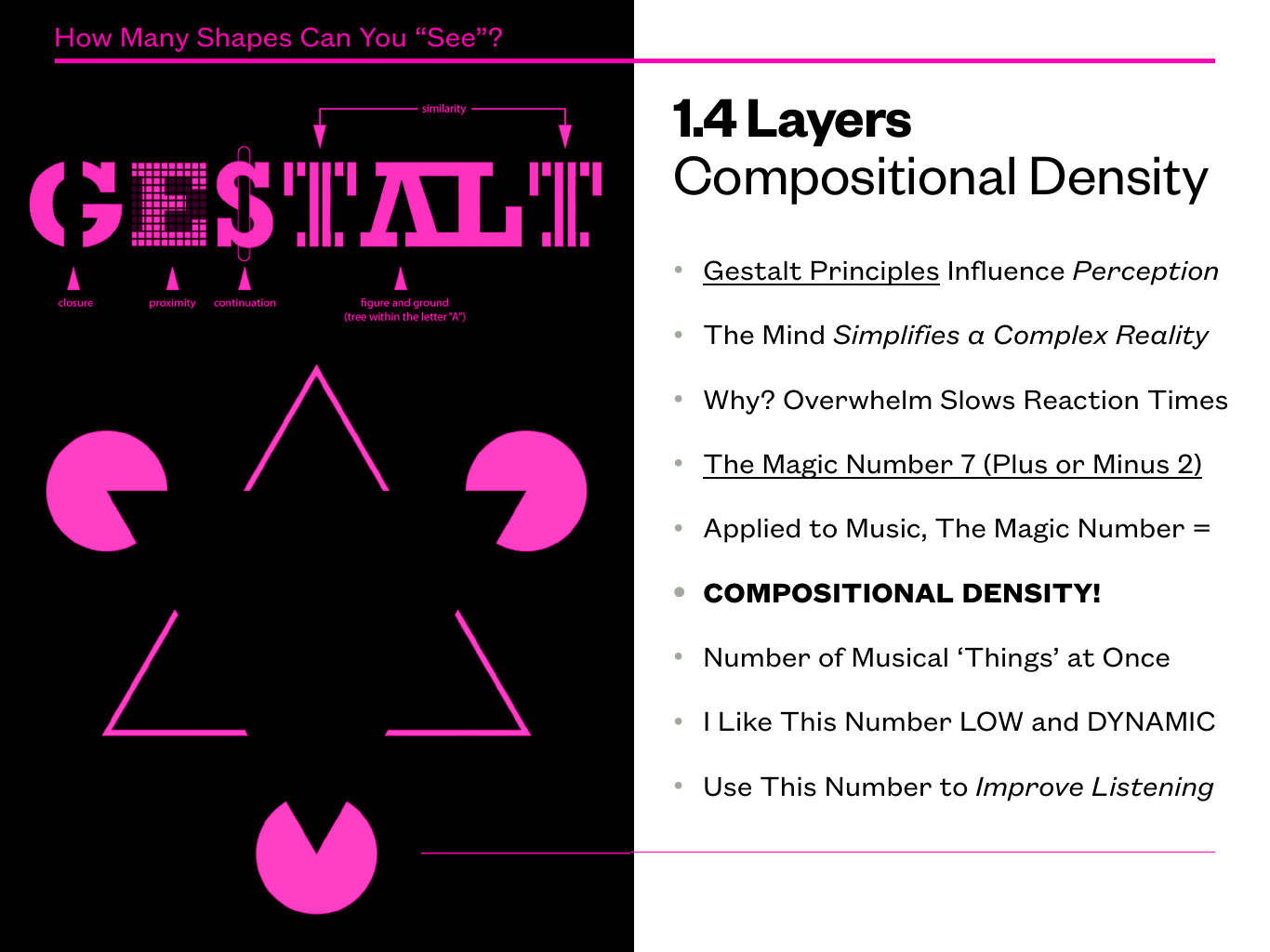
Monday, Arranging Tracks. Drop a song you love into your DAW, line it up to the grid, and mark where every section starts and ends. Then count how many things are playing at once in each section, which is called compositional density. Once the number creeps past about seven, an arrangement usually starts to feel cluttered. It’s homework, but the fun kind.
Tuesday, Mixing Dry. Gain staging means managing your volume levels when you mix: setting the level of every sound, group and bus, and trimming the little peaks that cause problems further down the chain. You’ll mix practice stems with gain staging, a clipper (which shaves off the loudest peaks) and ducking (turning one sound down so another can be heard), with no reverb and no delay. I’ve watched people who were fairly new to mixing beat the commercial master of a track this way, working from stems they were handed.
Wednesday, Flipping Sparks. A flip is a simple remix made by chopping up a sample, and the sample you flip is usually the face of the song. A very common way to do it is the MPC way: spread the sample across 16 pads and play it like drums, with some pieces reversed, some pitched up or down, some time stretched, until the melody has a groove of its own. A Spark is the seed idea you start from, something small and personal that you love. You flip a Spark.
Thursday, Making Beats. How to stop overthinking, the five phases in more detail, how to pick drum sounds as they play inside your song instead of alone in a folder, drum kits and rhythm.
Friday, Remixing Stems. Phase three, bottlenecks (whatever is slowing your output down), the three versions recipe, and a challenge: make high-quality stems of your own track and remix them to finish.
Questions before you register
Do I need Ableton?
No. Any DAW works.
Is it for beginners?
Every skill level is welcome. Every challenge has an easy version, with harder ones if you want to push, so you can pick the one that matches where you are.
Where does it happen?
Live on YouTube, on the Producer Dojo channel, at 12pm PT from Monday, October 12 to Friday, October 16.
Does it cost anything?
It’s free. Somebody in the Day 2 chat last time said they couldn’t believe it was free information, and I get it, but yes, free.
Will I finish a track this week?
Yes, as long as you do the assignments. This is human music making, so the work is still yours to do, and the five days hand you the steps.
Open the track you gave up on
If I had to boil the whole week down, it’s fractalization: you don’t need more and more different sounds, you need more versions of the sounds you already have. That’s what Trapezoid was, one sample in a pile of edits, and it’s what phase three does for the track sitting on your hard drive right now. Open it before Monday so it’s waiting for you when class starts.


